Heavy: Poems that Count
chapbook release note
content overview, acknowledgments, and helping monarchs
edited April 24, 2026
The narrative witness poems in the chapbook Heavy: Poems that Count span three decades of experience and they have been with me for a decade or more. Mostly revisions of poems in the original online Extinction Witness offerings, they all include numbers and/or refer to counting and water. In the preface, I reflect on an experience in 2005 that taught me how quantity fails intimacy. And the poem “Heavy” serves for the title because it includes micro and macroaggressions toward little ones, namely children and butterflies.
Dedication & Acknowledgments
I’ve officially dedicated Heavy to kids of all kinds, and my mother Barbara Bennett Mays is also with me this season. As her health declined with Alzheimer’s, Mom’s last thoughtful words to me were, the poetry has really worked for you.
Among the many ways to interpret Mom’s observation, I’m reflecting on how writing and sharing these poems in the raw made meaning of my existence when nothing else about my life made sense. Writing and sharing these poems worked for me. And I hope that the revisions in this chapbook collaboration are helpful in some way for readers, that the poems continue working for everyone’s benefit.
I thank the editors of Dark Matter: Women Witnessing and EVST professor Phil Condon’s Legacy anthology for publishing earlier versions of poems herein, Intersectional Interspecies Justice Conference for publishing a reading of an earlier version of “Welcome” on YouTube. Bryan Holland and Grace Vejvoda for contributing their time and talent, poet Mary-Jane Holmes (Fish Publishing, Ireland) for her edits and suggestions, Rockwood Press Executive Editor Eric Muhr for providing Heavy a right home, and everyone who supported the project directly and indirectly.
“Monarchs aren't doing well.”
The cover illustration of a monarch congregation by designer Grace Vejvoda is from a photo provided by conservation biologist Isis Howard, Xerces Society. Xerces Society reports that over the last forty years the western monarch butterfly population has declined by over 95% and the eastern population has declined by 80%. Once estimated in the tens-of-millions—too many to count—Xerces' November to December 2025 Western Monarch Count recorded just 12,260 monarchs. It's the third lowest population count since 1997 when the count began; all three lowest counts have occurred within the last six years and the lowest of the low in 2020 is off-the-chart at approximately 1,901 individuals.
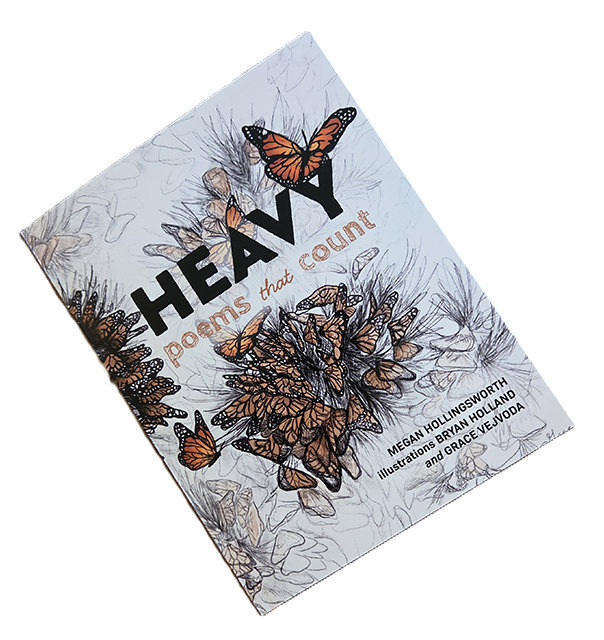
Heavy: Poems that Count (Rockwood Press, April 2026) includes ten narrative witness poems. Illustrations by artist Bryan Holland, based on photos provided by individuals and groups working for peaceful coexistence, compliment seven of the poems. Cover illustration of a monarch congregation by designer Grace Vejvoda is from a photo provided by conservation biologist Isis Howard, Xerces Society. Heavy also includes Holland’s illustration of a photograph taken during the release of Pollinator Posse’s “fostered” monarch butterflies for educational purposes at The Gardens at Lake Merrit in Oakland, California. Please read Xerces Society’s joint statement on how popular large-scale captive rearing can harm monarchs: Joint Statement Regarding Captive Breeding and Releasing of Monarchs
When I asked Isis Howard why recent western monarch counts have been so low, she mentioned short-term and long-term drivers, and said, “It's very challenging to pinpoint exact causes for year-to-year population changes, but oftentimes weather is involved” (personal communication, August 28, 2025). Heat waves with prolonged high temps (ground radiation) can contribute to “significant” caterpillar mortality and drought impacts milkweed availability during the breeding season. Isis explained that these short-term drivers are compounded by long-term drivers of North America's monarch declines, most importantly pesticide contamination and loss of overwintering and breeding habitat.
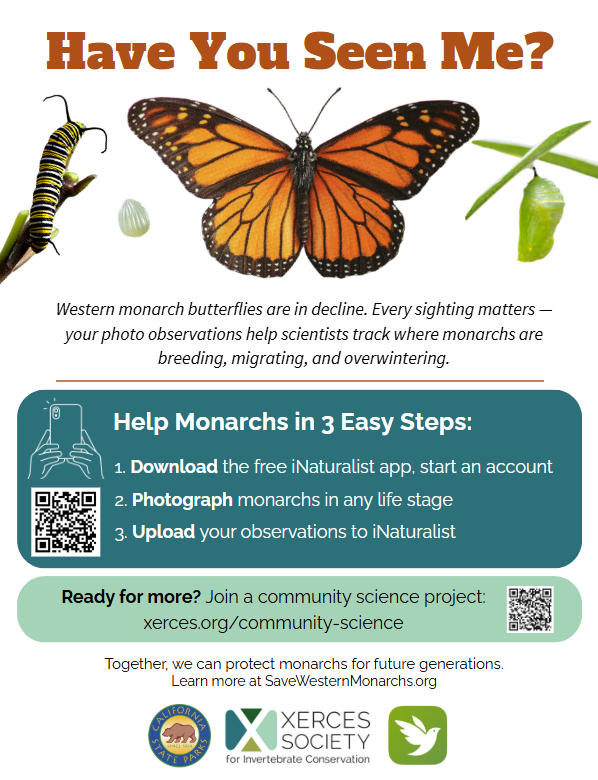
Isis also shared the good news that a shift has begun toward precautionary measures for pesticide use on millions of acres of western rangelands. And she emphasized that everyone is encouraged to help track observations through the Western Monarch Milkweed Mapper at iNaturalist and participate in the International Monarch Monitoring Blitz, a ten-day period beginning the last Friday of July.
As I complete this release note on the evening of April 10, 2026, humanity celebrates NASA's ten-day Artemis II mission with the successful return of the Orion spacecraft Integrity’s four astronauts. Surely beings smart enough to make it safely around the moon and back can be smart and wise enough to peacefully coexist with butterflies at home, smart and wise enough to embrace kids of all kinds, ensuring each and every one healthy water, food, and shelter that they might learn and grow to their full potential. Together, we can do all of this too.
Links from Xerces Society about monarchs and how to help them:
Monarch Butterfly Conservation
Monarch Listing Delayed (earliest decision fall 2026)
Western Monarch Numbers Remain at Historic Low
© 2026 Megan Hollingsworth | All Rights Reserved